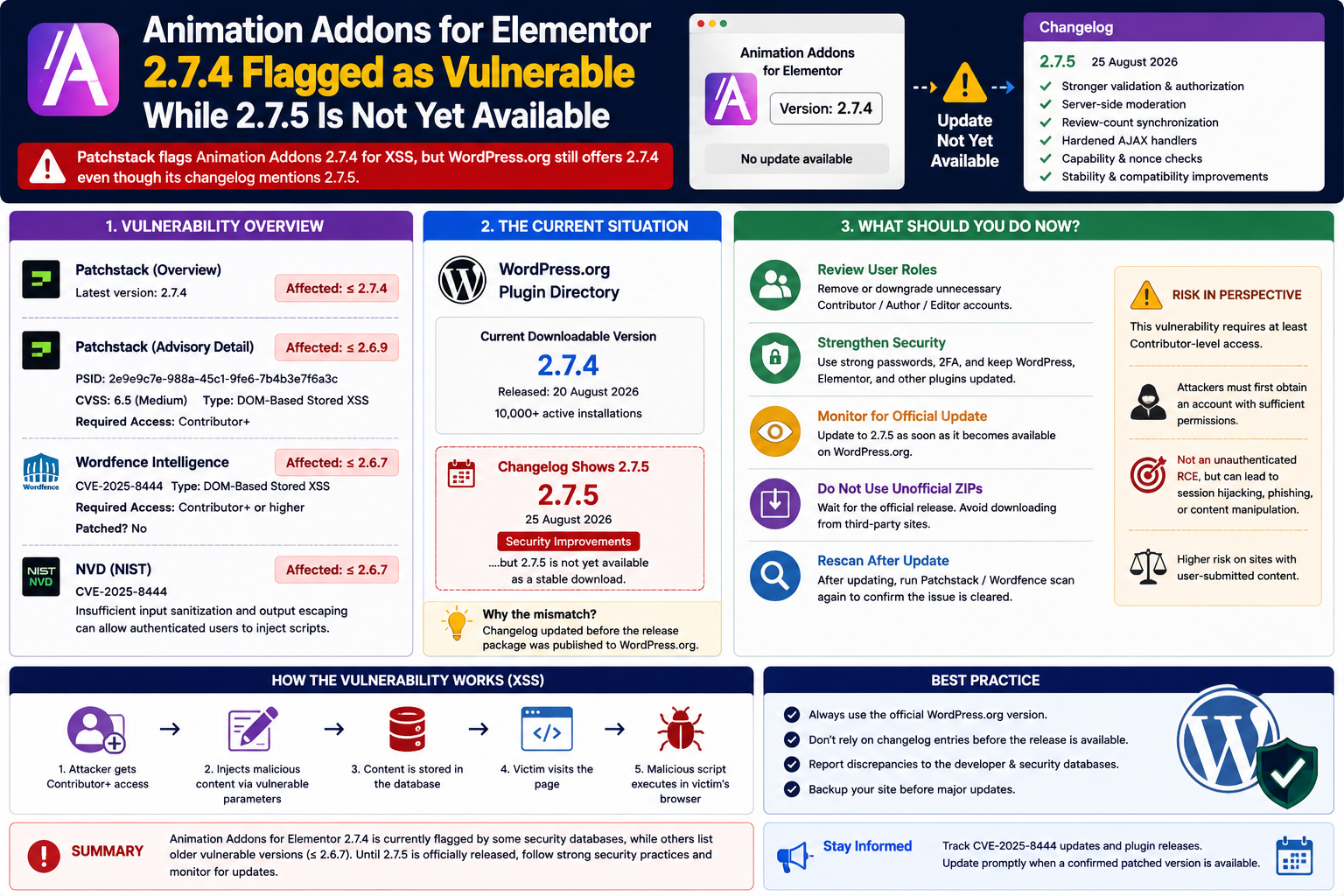
There is currently a confusing security situation around Animation Addons for Elementor.
A site owner running:
Animation Addons for Elementor
Version 2.7.4
may receive a Patchstack warning stating that the plugin is affected by a Cross-Site Scripting vulnerability.
At the same time:
WordPress.org latest downloadable version
→ 2.7.4
while the plugin’s own WordPress.org changelog already contains:
Version 2.7.5
25 August 2026
with several security-related changes.
That raises an obvious question:
If 2.7.4 is considered vulnerable and 2.7.5 exists in the changelog, why can’t WordPress users actually update to 2.7.5?
There is an additional complication: the major vulnerability databases currently do not agree on the exact affected version range.
That makes this more than a simple “click Update” situation.
Current WordPress.org Version: 2.7.4
As of August 27, 2026, the current WordPress.org plugin listing identifies 2.7.4 as the available release.
The plugin has approximately:
10,000+ active installationsand 2.7.4 was released on August 20, 2026.
So if you visit:
Dashboard
→ Plugins
and WordPress says:
Animation Addons for Elementor
Version 2.7.4
No update available
that is currently consistent with what the WordPress.org directory is serving.
This is not necessarily a WordPress update-cache problem.
Yet the Changelog Already Lists 2.7.5
The strange part is that current WordPress.org mirrors now contain this entry:
Animation Addons for Elementor v2.7.5
25 August 2026
The listed changes include:
- stronger Post Rating Form validation and authorization,
- server-side moderation enforcement,
- review-count synchronization,
- hardened AJAX handlers,
- stronger capability checks,
- nonce checks,
- general stability and compatibility improvements.
So we currently have:
CHANGELOG
2.7.5 exists
✓

WORDPRESS.ORG INSTALLABLE VERSION
2.7.5 available
✗
That usually means the plugin’s readme.txt or changelog was updated before the corresponding release package became the directory’s stable version.
It may simply be a release-publishing delay, but until the package is actually available, users cannot safely treat an unreleased changelog entry as an installed security patch.
Do Not Download a Random “2.7.5” ZIP From Another Website
If WordPress.org still supplies 2.7.4, do not respond by searching for:
Animation Addons 2.7.5 downloadand installing a ZIP from an unofficial GPL mirror or file-sharing website.
For a security update, the integrity of the plugin package is particularly important.
Wait for:
WordPress.orgor the plugin developer’s verified official distribution channel.
The presence of a 2.7.5 changelog entry alone does not prove that any third-party ZIP claiming to be 2.7.5 is genuine.
Patchstack Currently Flags 2.7.4
Patchstack’s main vulnerability history page currently lists two unresolved Animation Addons vulnerabilities and identifies the plugin’s latest version as:
2.7.4For the June 9 XSS entry, that overview currently reports:
Affected:
<= 2.7.4
and another XSS entry dated March 1 is also currently shown as affecting:
<= 2.7.4So the user’s concern is legitimate.
According to that Patchstack summary, installing the latest version currently available from WordPress.org does not clear the vulnerability status.
But Patchstack’s Own Detail Page Says Something Different
This is where the situation becomes especially confusing.
Opening the specific Patchstack advisory linked for the June vulnerability currently shows:
Affected versions:
<= 2.6.9
rather than:
<= 2.7.4and it states:
No official patch availableThe advisory identifies the vulnerability as Cross-Site Scripting, requiring Contributor-level access, with a CVSS score of approximately 6.5.
So Patchstack currently contradicts itself:
Patchstack vulnerability overview
<= 2.7.4

Patchstack individual advisory
<= 2.6.9
That inconsistency should be acknowledged instead of silently assuming either value is definitely correct.
Wordfence Says the Vulnerability Ends at 2.6.7
The linked vulnerability corresponds to:
CVE-2025-8444Wordfence Intelligence describes it as:
Authenticated Contributor+ DOM-Based Stored Cross-Site Scripting via multiple parameters.
Wordfence currently states that affected versions are:
<= 2.6.7and still labels the vulnerability as:
Patched? NoIts remediation says there is no known patch and suggests removing/replacing the software where appropriate based on risk tolerance.
So now we have three different version ranges:
| Source | Currently reported affected versions |
|---|---|
| Patchstack overview | <= 2.7.4 |
| Patchstack advisory detail | <= 2.6.9 |
| Wordfence Intelligence | <= 2.6.7 |
That is a significant discrepancy.
NVD Also Says 2.6.7
The U.S. National Vulnerability Database entry for CVE-2025-8444 currently describes Animation Addons as vulnerable through:
2.6.7The NVD description says insufficient input sanitization and output escaping can allow authenticated users with Contributor-level access or higher to inject scripts into affected content.
So NVD currently agrees with Wordfence:
NVD:
<= 2.6.7

Wordfence:
<= 2.6.7
while Patchstack’s current records have broader ranges.
Why Might Patchstack Show 2.7.4?
There are several possibilities.
The most obvious is that the security database has re-evaluated later releases and determined that the vulnerable JavaScript/code path remained present after 2.6.7.
Another possibility is a metadata synchronization problem.
Patchstack’s main plugin overview may have extended the affected range automatically because no version was explicitly identified as patched.
That could produce logic such as:
Known vulnerability
+
No confirmed patched version
+
Latest plugin = 2.7.4
↓
Display affected <= 2.7.4
while the underlying CVE record still says:
<= 2.6.7I cannot confirm which explanation is correct from the currently published records.
The important point is:
The public vulnerability databases are inconsistent right now.
Do Not Assume 2.7.4 Is Safe Just Because It Is Newer
Normally this logic would be reasonable:
Vulnerability affects <= 2.6.7

Installed:
2.7.4

Therefore:
Safe
But the current Patchstack warning complicates that conclusion.
If a security scanner is explicitly warning:
2.7.4 vulnerableand the vendor has simultaneously added a security-focused:
2.7.5entry to its changelog, I would not simply dismiss the alert.
The safer position is:
2.7.4 security status
= currently disputed
until either:
- Patchstack corrects the affected version range,
- Wordfence/NVD update their data,
- the vendor confirms which version contains the fix,
- or 2.7.5 becomes publicly downloadable and is confirmed as patched.
Does 2.7.5 Definitely Fix CVE-2025-8444?
Not from the changelog alone.
This distinction matters.
The 2.7.5 changelog mentions security improvements involving:
Post Rating Form
AJAX handlers
autocomplete endpoints
capability checks
nonce checks
The vulnerability in CVE-2025-8444 is described by Wordfence as a DOM-Based Stored XSS through multiple parameters.
Those descriptions do not clearly match.
Therefore it would be inaccurate to state:
Version 2.7.5 definitely patches CVE-2025-8444.
It may.
But the currently published changelog does not explicitly name:
CVE-2025-8444or say:
Fixed DOM-Based Stored XSSSo confirmation from the developer or vulnerability database would be preferable.
What Does the Vulnerability Allow?
According to Wordfence and NVD, CVE-2025-8444 is an authenticated Stored Cross-Site Scripting vulnerability.
The attacker must have at least:
Contributorlevel access.
The simplified attack chain is:
Attacker obtains Contributor account
↓
Supplies malicious content/parameters
↓
Plugin insufficiently sanitizes or escapes it
↓
Payload becomes stored in content
↓
Another user loads affected page
↓
Malicious JavaScript executes
Because the script executes in the victim’s browser, the potential impact can include:
session actions
admin-side actions
malicious redirects
content manipulation
credential/phishing UI injection
depending on where and under whose session the payload executes.
This Is Not an Unauthenticated Critical RCE
The vulnerability should still be addressed, but it is useful to keep the risk in perspective.
The public records describe:
Required privilege:
Contributor+
and assign it a medium-range CVSS score around:
6.4 / 6.5So this is not currently described as:
Unauthenticated Remote Code Executionor:
Unauthenticated admin takeoverThat matters when deciding what to do while waiting for a release.
Sites Without Contributor Accounts Have Less Exposure
Suppose your WordPress users are only:
Administrator
Editor
Customer
Subscriber
and only trusted administrators/editors can modify Elementor content.
An attacker cannot directly exploit a Contributor+ authenticated vulnerability without first obtaining an account with sufficient permissions.
That reduces practical exposure.
It does not make vulnerable code desirable, but it may allow you to manage the risk temporarily while waiting for a confirmed update.
Sites With User-Contributed Content Need More Caution
The situation changes if your site gives untrusted people:
Contributor
Author
Editor
access.
Examples include:
multi-author blogs
community publishing sites
client portals
editorial networks
membership sites with publishing permissions
For those sites, the prerequisite for exploitation may already exist.
I would treat the unresolved version discrepancy more seriously there.
What I Would Do If Running 2.7.4 Right Now
Because there is no universally agreed patched version currently downloadable, I would use a risk-based approach.
1. Confirm the Installed Version
Go to:
Plugins
→ Installed Plugins
Check:
Animation Addons for Elementor
Version 2.7.4
Do not rely only on a security scanner’s cached inventory.
2. Confirm That WordPress Truly Has No Update
Go to:
Dashboard
→ Updates
→ Check Again
At the time of verification, WordPress.org still identifies 2.7.4 as the available release, despite showing a 2.7.5 changelog entry.
So not seeing an update is currently expected.
3. Do Not Ignore Patchstack’s Warning Yet
Given the discrepancy between:
Patchstack
Wordfence
NVD
I would not mark the issue as:
False Positivepermanently yet.
Wait for the databases or developer to reconcile the affected range.
4. Review WordPress User Roles
Go to:
Users
→ All Users
Look specifically for accounts with:
Contributor
Author
Editor
Administrator
permissions.
Delete or downgrade unused accounts.
If a user only needs to read the site:
Subscriberis safer than Contributor.
5. Reset Credentials for Suspicious/Unused Accounts
Because exploitation requires authenticated access, account security matters.
Review:
inactive accounts
old contractor accounts
shared logins
weak passwords
unexpected administrator/editor accounts
Remove anything that should no longer exist.
6. Check Activity Logs if Available
If the site uses:
Wordfence
Solid Security
WP Activity Log
Patchstack
host security logging
review recent content edits and account activity.
Look especially for changes made by:
Contributor
Author
accounts.
7. Consider Temporarily Disabling the Plugin
If:
the site does not depend heavily on Animation Addonsthe safest temporary mitigation is:
Deactivate pluginuntil a confirmed patched release is available.
However, test this first on staging.
Elementor pages that use Animation Addons widgets can lose styling, content, or functionality while the plugin is disabled.
8. Do Not Delete It Before Testing
If pages rely on its Elementor widgets, immediately deleting the plugin can leave frontend layouts broken.
Prefer:
Backup
↓
Staging
↓
Deactivate
↓
Inspect affected pages
before making the production decision.
9. Update to 2.7.5 Only When It Is Actually Available
Once WordPress offers:
2.7.5update promptly.
Then check:
Plugins
→ Version 2.7.5
rather than assuming the update succeeded because the changelog changed.
After that, rerun:
Patchstack scan
Wordfence scan
host vulnerability scanner
and see whether the vulnerability is cleared.
10. Verify the Security Databases Again
Even after 2.7.5 arrives, check whether the advisory changes from:
No known patchto something like:
Patched in 2.7.5That confirmation is more meaningful than a generic changelog entry saying:
Security improvementsThe Plugin Has Had Several Recent Security Issues
Patchstack currently lists multiple vulnerabilities in Animation Addons’ history, including:
- Stored XSS issues,
- an SVG-related Stored XSS fixed around the 2.7.0 line,
- several Contributor+ XSS reports around 2.6.x,
- and an older arbitrary content deletion issue.
For example, a separate Author+ Stored XSS vulnerability affecting versions before 2.7.0 was publicly documented and marked as patched in 2.7.0.
That makes timely updates particularly important for this plugin.
There Is Also a Separate 2.6.3 XSS Vulnerability
Do not confuse CVE-2025-8444 with several other XSS vulnerabilities disclosed around the same time.
Patchstack has separate entries affecting:
<= 2.6.3that were patched in:
2.6.4for some affected components.
So a security scanner may show multiple Animation Addons alerts simultaneously.
Always compare:
CVE
PSID
affected range
published date
rather than assuming all the XSS alerts describe one vulnerability.
Why the Exact CVE Matters
For the linked June advisory, the relevant identifier is:
CVE-2025-8444Wordfence and NVD both currently associate that CVE with:
<= 2.6.7If your Patchstack dashboard instead says:
<= 2.7.4take a screenshot and include the CVE/PSID when reporting it.
Otherwise the developer may look up a different Animation Addons XSS issue and give you an answer that does not resolve the actual warning.
A Good Message to Send the Plugin Developer
A concise security report would be:
Patchstack currently flags Animation Addons for Elementor 2.7.4 as vulnerable to XSS. The plugin directory still offers 2.7.4 as the latest downloadable version, but the WordPress.org changelog already includes a 2.7.5 entry dated August 25 with security improvements.
Could you please confirm:
- Whether version 2.7.4 is affected by CVE-2025-8444 / the Patchstack advisory published June 9;
- Which version fully patches that vulnerability;
- Whether 2.7.5 is intended to be the security release;
- When 2.7.5 will be published as the stable WordPress.org download?
Patchstack’s plugin overview currently says
<=2.7.4, while the individual Patchstack advisory says<=2.6.9and Wordfence/NVD say<=2.6.7, so clarification would be helpful.
That highlights the exact problem without overstating the vulnerability.
Should You Roll Back to 2.6.9?
No.
Rolling backward is not a sensible security response.
Older versions have their own known vulnerabilities.
For example, Patchstack records multiple XSS issues affecting 2.6.x releases, while another vulnerability was only patched in 2.7.0.
Do not do:
2.7.4
↓
2.6.7
just because one database identifies 2.6.7 as the last affected version.
Older software is not safer here.
Should You Manually Patch the JavaScript?
I would not recommend attempting to patch:
assets/js/wcf-addons.min.json a production site unless you have verified the vulnerable source code and understand the required sanitization/escaping fix.
Wordfence specifically references that JavaScript asset in its vulnerability record.
Editing a minified production bundle has several problems:
easy to patch incorrectly
hard to audit
overwritten on update
may break Elementor widgets
cannot prove all vulnerable parameters are fixed
A vendor release is preferable.
What If Patchstack Keeps Warning After 2.7.5?
Do not immediately assume the update failed.
Security databases can lag behind plugin releases.
Verify:
Installed version:
2.7.5

WordPress.org:
2.7.5 stable

Patchstack advisory:
patched version?
If the plugin is updated but Patchstack still says:
<= 2.7.4 vulnerablethen 2.7.5 should logically fall outside that affected range.
However, if Patchstack still shows:
No patch availablewait for confirmation or contact Patchstack with the updated package/version information.
The Biggest Problem Right Now Is the Release/Metadata Mismatch
The unusual part is not merely that a vulnerability exists.
The unusual combination is:
Security database:
Latest version 2.7.4 is vulnerable

WordPress.org:
Latest installable version 2.7.4

WordPress.org changelog:
2.7.5 already documented

Actual 2.7.5 update:
not yet offered
That leaves site owners unable to follow the standard advice:
Update to patched versionbecause the next release is documented but not yet distributed.
Most Likely Explanation
At the moment, the most plausible explanation is:
- The developer has prepared or documented 2.7.5.
- Its changelog was pushed to WordPress.org on August 25.
- The directory is still serving 2.7.4 as the stable release.
- Vulnerability databases disagree about whether the June XSS remained present beyond 2.6.7/2.6.9.
- Patchstack’s overview is conservatively treating 2.7.4 as affected because no confirmed patched version has been recorded.
That final point is an inference from the conflicting public data, not something Patchstack or the developer has explicitly confirmed.
Direct Answer
Yes, there is currently a real inconsistency.
As of August 27, 2026:
WordPress.org downloadable version:
2.7.4
while:
WordPress.org changelog:
2.7.5 dated August 25, 2026
and 2.7.5 contains several security-related changes.
Patchstack’s plugin vulnerability overview currently identifies the June XSS as affecting:
<= 2.7.4However, the individual Patchstack advisory currently says:
<= 2.6.9while Wordfence and NVD both say:
<= 2.6.7for CVE-2025-8444.
Therefore I would not claim definitively that 2.7.4 is either vulnerable or patched until the vendor/security databases reconcile the records.
For now:
keep WordPress/Elementor updated
restrict Contributor/Author access
remove unused accounts
monitor the plugin update
do not download unofficial 2.7.5 ZIPs
consider temporarily disabling the plugin on higher-risk sites
update to 2.7.5 when it becomes officially available
then rerun the vulnerability scan
Most importantly, the developer should clarify whether 2.7.5 is the intended fix for CVE-2025-8444 and publish it as the stable WordPress.org release if so.
